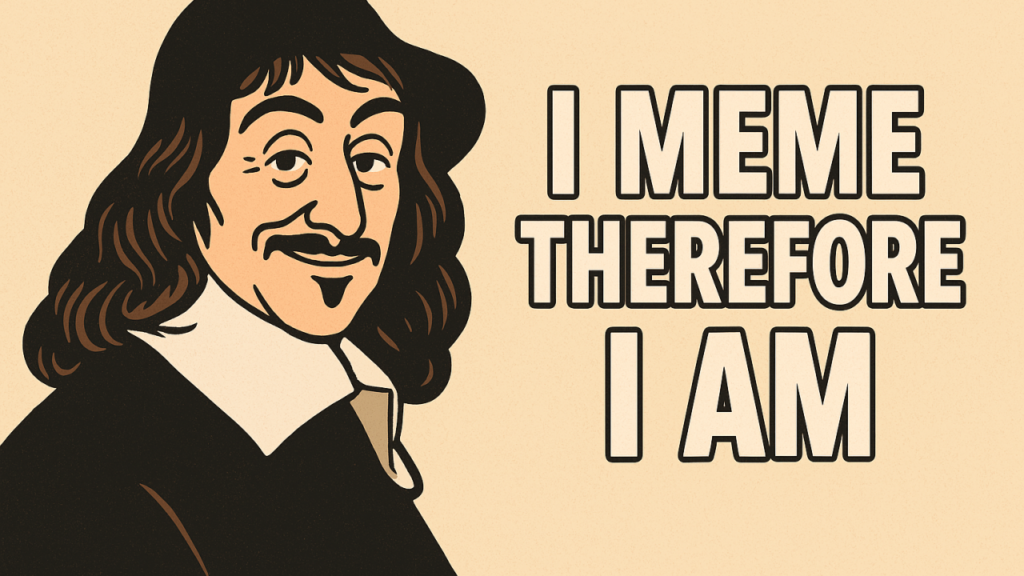
I think therefore I am meme represents one of the internet’s most brilliant intersections of ancient philosophy and modern humor.
This viral phenomenon transforms René Descartes’ profound philosophical statement “cogito, ergo sum” into accessible, relatable content that resonates with millions across social media platforms.
From TikTok animations to Reddit threads, this meme has evolved beyond simple jokes to become a cultural touchstone that makes existential questions surprisingly entertaining.
Understanding this meme’s origins, variations, and cultural impact reveals fascinating insights about how philosophy thrives in the digital age.
Table of Contents
The Origin of Cogito Ergo Sum
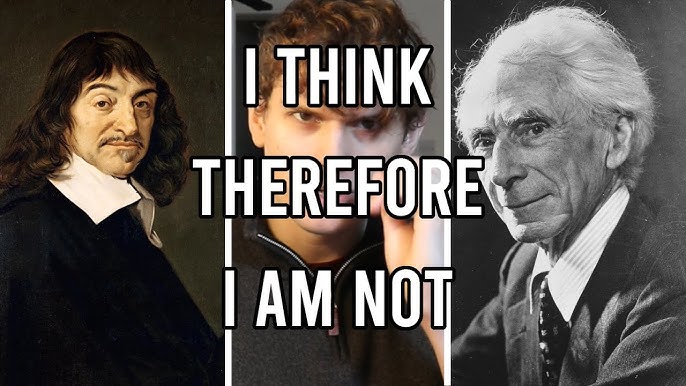
René Descartes introduced his famous statement in 1637 through “Discourse on the Method.” The French mathematician and philosopher sought to establish certain knowledge through methodic doubt.
He questioned everything except one undeniable truth: the act of thinking proves existence. This revolutionary idea became foundational to Western philosophy and rational thought.
The Latin phrase “cogito, ergo sum” translates directly to “I think, therefore I am.” This simple statement carries profound implications about consciousness, reality, and self-awareness.
Descartes’ Philosophical Context
Descartes developed his philosophy during an era of intellectual uncertainty and religious turmoil. He wanted to rebuild knowledge on an unshakeable foundation.
Through systematic doubt, he eliminated all beliefs that could possibly be questioned. Even sensory experiences and mathematical truths fell under his skeptical scrutiny.
The one thing he couldn’t doubt was his own existence while doubting. This self-evident truth became his “first principle” of philosophy.
Why “I Think Therefore I Am” Became a Meme
The phrase’s simplicity makes it perfect for meme culture. Six words capture a complex philosophical argument accessible to anyone.
Its universal applicability to existential questions creates countless meme opportunities. Everyone experiences moments of questioning reality and existence.
The inherent absurdity of proving existence through thinking resonates with internet humor. Modern audiences appreciate the paradoxical nature of consciousness.
The Viral Descartes Comic Explained
The “Dude Are You Real” meme originated from Twitter user @ThisStupidTwink in March 2024. This webcomic became instantly viral across multiple platforms.
The comic features two friends questioning each other’s existence while high. One asks “Dude are you real?” and the other responds “Dude… I think I am?”
René Descartes suddenly appears exclaiming “That’s actually pretty solid evidence!” This unexpected philosophical validation creates the meme’s humor.
How the Meme Spread Across Platforms
TikTok user @coalbones created a voiceover in September 2024 that amplified the meme’s reach. This audio version gained over 8,500 likes and inspired countless animations.
YouTube animator CamTheCan produced a viral video version garnering over 118,000 views. The animation brought the comic to life with expressive characters.
TikToker @sophiathedookie’s animation accumulated over 3.3 million views in six months. The meme’s momentum continued building through various creative interpretations.
Understanding the Philosophy Behind the Joke
The meme brilliantly simplifies Descartes’ complex epistemological argument. It makes philosophical reasoning accessible through relatable scenarios.
Descartes argued that even radical doubt confirms the doubter’s existence. The act of questioning reality requires a conscious entity to do the questioning.
This creates an unbreakable logical chain: thinking occurs, therefore a thinker exists. The meme captures this perfectly through casual conversation.
Modern Interpretations and Variations
Contemporary meme creators apply the Descartes format to countless scenarios. From video game characters to workplace situations, the template proves endlessly adaptable.
Some versions feature cats claiming “I do not think therefore I do not am.” This clever inversion plays with the original logic for comedic effect.
Others incorporate pop culture references like Arcane, ENA, and Severance characters. The meme transcends philosophical circles into mainstream entertainment.
The Stoner Philosophy Connection
The original meme depicts friends in an altered state questioning reality. This connects perfectly with stereotypical “deep thoughts while high” scenarios.
Cannabis culture has long embraced existential questions and philosophical musings. The combination of mind-altering substances and profound questions creates natural comedy.
Descartes himself engaged in thought experiments requiring altered perspectives. The meme honors this tradition while making it hilariously accessible.
Psychology of Existential Humor
Humans naturally question their existence during moments of deep reflection. These universal experiences make existential memes deeply relatable.
Humor helps us process anxiety about consciousness and mortality. Laughing at existence paradoxes provides psychological relief from heavy topics.
The meme format allows people to engage with philosophy without formal education. It democratizes complex ideas through accessible entertainment.
Comparing Descartes to Other Philosophy Memes
Plato’s Cave allegory memes explore similar themes of reality versus perception. Socrates’ “I know that I know nothing” generates comparable humor.
Nietzsche’s nihilism provides darker existential comedy for internet culture. Each philosopher offers unique meme potential based on their ideas.
Descartes stands out because his argument is simultaneously simple and profound. The directness of “I think therefore I am” makes perfect meme material.
The Role of Animation in Meme Evolution
Animated versions transform static comics into engaging narratives. Voice acting adds personality and emotional depth to philosophical concepts.
Hydraulic Beanbag’s extended animation adds layers where Descartes gets high too. This meta-humor acknowledges the absurdity of the entire scenario.
Animation allows creators to visualize abstract philosophical concepts. Moving images make complex ideas more digestible for modern audiences.
TikTok’s Influence on Philosophy Memes
TikTok’s short-form video format perfectly suits philosophical punch lines. Quick setup and delivery match the platform’s consumption patterns.
The platform’s algorithm spreads philosophical content to unexpected audiences. People who’d never read Descartes encounter his ideas through memes.
Sound-based virality means one voiceover can spawn thousands of variations. Each creator adds their unique spin while maintaining the core joke.
Reddit Philosophy Communities Response
Subreddits like r/philosophymemes celebrate these viral moments enthusiastically. The “Dude Are You Real” comic gained 1,400 upvotes quickly.
Reddit users appreciate the accurate philosophical representation within humor. They value memes that actually understand the concepts they reference.
These communities serve as quality filters separating clever philosophy jokes from shallow references. Their engagement determines which memes achieve lasting status.
Educational Value of Philosophy Memes
Memes introduce philosophical concepts to people who’d never take philosophy courses. They spark curiosity about deeper intellectual traditions.
Teachers and professors increasingly use memes to engage students. Relatable humor makes challenging material more approachable and memorable.
The format encourages further research into the actual philosophers and ideas. A funny meme often becomes a gateway to serious philosophical study.
Cogito Ergo Sum in Popular Culture
Beyond memes, Descartes’ phrase appears in movies, TV shows, and literature. The Matrix trilogy explores similar questions about reality and thinking.
Science fiction frequently references cogito arguments when addressing AI consciousness. If artificial intelligence thinks, does it exist?
The phrase has become shorthand for self-awareness in cultural discourse. Its recognition spans far beyond academic philosophical circles.
Philosophical Critiques Within Memes
Some meme variations highlight criticisms of Descartes’ reasoning. Philosophers like Nietzsche challenged the assumptions underlying cogito.
Memes questioning “What is ‘I’?” reference real philosophical debates. They playfully engage with substance ontology and the nature of self.
The cat meme “I do not think therefore I do not am” satirizes logical fallacies. It demonstrates understanding of proper logical inference.
The “That’s Solid Evidence” Format
The phrase “That’s actually pretty solid evidence” became its own meme template. It’s applied whenever someone makes unexpectedly valid points.
The format works by validating absurd but technically correct reasoning. This celebrates logical consistency regardless of context.
Descartes’ approval adds authority to otherwise ridiculous scenarios. The philosopher’s endorsement makes anything seem philosophically legitimate.
Cross-Cultural Philosophy Meme Variations
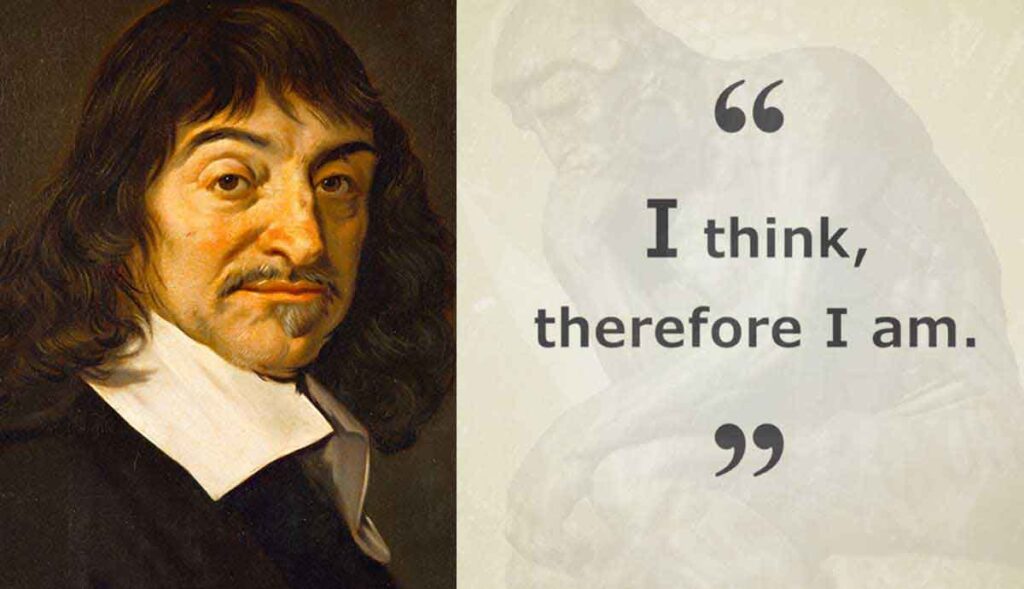
Different cultures adapt the meme to their philosophical traditions. Eastern philosophy offers its own existential questions and paradoxes.
Buddhist concepts of no-self create interesting counterpoints to Cartesian thinking. “I think, therefore I am not” represents alternative perspectives.
These cross-cultural variations enrich global meme culture. They demonstrate philosophy’s universal appeal across different traditions.
Impact on Philosophy Student Culture
Philosophy majors embrace these memes as insider jokes. They signal membership in a community that understands complex ideas.
Memes provide stress relief during intensive philosophical study. Laughing at Descartes makes reading his dense texts more bearable.
They also serve as study tools through humorous mnemonics. Remembering the meme helps students recall the actual philosophical argument.
Meme Generators and Customization
Imgflip and similar platforms offer “I Think Therefore I Am” meme templates. Users can easily create customized versions with personal touches.
The democratization of meme creation spreads philosophical concepts further. Anyone can participate in philosophical discourse through humor.
This accessibility removes barriers between professional philosophy and public engagement. Memes become a form of participatory philosophy.
The Performative Nature of Thinking
The meme highlights thinking as an active performance. Descartes emphasized the present-tense aspect of cogito.
“I think” represents an ongoing action, not a static state. The meme captures this immediacy through real-time dialogue.
This performative quality makes the philosophy more dynamic and relatable. Thinking becomes something we do rather than something we are.
Existential Crisis Humor
The meme taps into common experiences of existential questioning. Many people have moments of wondering if they’re real.
Anxiety about existence becomes less threatening when packaged as humor. The meme format provides a safe way to explore scary questions.
Shared laughter creates community around universal human experiences. We’re all questioning reality together, and that’s somehow comforting.
Philosophy in the Digital Age
Social media platforms become new venues for philosophical discourse. Memes represent modern dialectical methods of exploring ideas.
The speed of digital communication allows rapid iteration of concepts. Ideas evolve through collective participation rather than individual contemplation.
This democratizes philosophy while potentially oversimplifying complex arguments. The balance between accessibility and accuracy remains challenging.
Descartes Would Approve (Maybe)
René Descartes sought to make philosophy accessible to broader audiences. He wrote in French, not just Latin, for this reason.
His emphasis on clear and distinct ideas aligns with meme simplicity. The format’s directness might appeal to his methodological approach.
However, he might question whether memes truly capture philosophical depth. The joke’s accuracy doesn’t guarantee genuine understanding.
Literary References in Meme Culture
The meme connects to a long tradition of philosophical satire. Voltaire and others used humor to critique and explain philosophy.
Modern memes continue this tradition through new mediums. The spirit of playful intellectual engagement remains constant.
References to other philosophers and texts enrich the meme’s layers. Educated audiences appreciate these sophisticated connections.
The Importance of Context
Understanding the meme fully requires knowing Descartes’ actual philosophy. Without context, it’s just a funny interaction.
The meme works on multiple levels simultaneously. Surface humor attracts casual viewers while deeper meaning rewards knowledge.
This layered approach makes philosophy memes particularly satisfying. They offer something for everyone regardless of background.
Viral Voiceover Culture
Audio memes like @coalbones’ voiceover create new engagement patterns. People quote lines in everyday conversation.
The specific delivery and tone become part of the meme’s identity. “René Descartes??!” carries particular comedic timing.
Voiceover culture allows non-visual participation in meme communities. People can engage through listening and responding.
Meme Longevity and Evolution
The “I Think Therefore I Am” meme shows remarkable staying power. It continues generating new variations months after initial posting.
Quality philosophical memes tend to last longer than trending jokes. They offer timeless appeal beyond momentary relevance.
Evolution through reinterpretation keeps the meme fresh and engaging. Each new version adds to the collective understanding.
Academic Recognition of Meme Philosophy
Some philosophy departments acknowledge memes as legitimate cultural phenomena. They represent how ideas circulate in contemporary society.
Research papers analyze meme formats as modern rhetorical devices. Academic interest validates the intellectual dimension of internet humor.
This recognition bridges traditional philosophy and digital culture. It acknowledges how knowledge transmission has transformed.
Creating Your Own Philosophy Memes
Successful philosophy memes require understanding the actual concepts. Accuracy enhances rather than diminishes the humor.
Visual simplicity combined with conceptual depth works best. The format should complement rather than complicate the idea.
Timing and delivery matter as much as philosophical content. The punchline needs proper setup to land effectively.
The Future of Philosophy Memes
As platforms evolve, so will meme formats for philosophical content. VR and AR might create immersive philosophical experiences.
AI-generated content could produce increasingly sophisticated philosophy jokes. Machine learning might identify optimal meme structures.
The fundamental human desire to question existence ensures continued relevance. Philosophy memes will adapt to whatever mediums emerge next.
Why We Need Philosophy Humor
Serious philosophical inquiry can feel intimidating and exclusive. Humor opens doors to important questions about existence.
Laughter makes difficult topics less overwhelming and more approachable. It invites participation from people who’d otherwise avoid philosophy.
The combination of wisdom and wit represents intellectual tradition’s best qualities. Philosophy has always benefited from clever communication.
Social Commentary Through Philosophy Memes
The stoner context satirizes dismissive attitudes toward altered consciousness. It suggests deep thoughts can emerge from unexpected places.
The meme challenges intellectual elitism by making philosophy accessible. It democratizes traditionally exclusive academic domains.
Descartes’ enthusiastic approval validates non-traditional philosophical thinking. Authority figures endorsing casual wisdom creates subversive humor.
Meme Marketing and Philosophy
Brands occasionally attempt philosophy meme marketing with mixed results. Authentic engagement with ideas works better than shallow references.
Educational institutions successfully use memes to attract students. They demonstrate relevance and cultural awareness.
Philosophy departments grow enrollment through meme-based social media presence. Humor proves an effective recruitment tool.
The Cogito in Gaming Culture
Video games exploring consciousness often reference Descartes directly. “I Have No Mouth and I Must Scream” engages similar themes.
Gaming communities create memes combining philosophy with game scenarios. Characters questioning their existence within game worlds.
This intersection reveals how digital experiences raise genuine philosophical questions. Virtual existence prompts real existential reflection.
Music and Philosophy Meme Mashups
Some creators combine philosophical memes with music for enhanced virality. Audio-visual combinations increase emotional resonance.
Song parodies incorporating Cartesian philosophy circulate widely. Musical hooks make philosophical concepts more memorable.
This multimedia approach expands philosophy’s reach into new audiences. Different modalities of engagement attract diverse participants.
Philosophy Meme Aesthetics
Visual design elements contribute significantly to meme success. Clean typography and clear imagery enhance message delivery.
The comic strip format recalls traditional philosophical dialogue structures. It modernizes Socratic method through visual conversation.
Aesthetic choices signal whether a meme targets casual or educated audiences. Design literacy matters for effective communication.
Generational Differences in Philosophy Humor
Gen Z particularly embraces existential humor as coping mechanism. Economic and environmental uncertainty fuel philosophical questioning.
Millennials appreciate the nostalgia of early internet philosophy communities. They bridge traditional academics and meme culture.
Boomers sometimes miss meme references but often appreciate underlying philosophy. Generational gaps create interesting communication challenges.
The Paradox of Simple Profundity
Descartes’ statement is simultaneously obvious and revolutionary. Everyone knows they exist, yet proving it philosophically is complex.
Memes highlight this paradox by treating deep philosophy casually. The humor comes from juxtaposition of weight and lightness.
Simple language expressing profound ideas represents philosophy’s ultimate goal. Memes accidentally achieve what academic writing sometimes fails to accomplish.
Mental Health and Existential Memes
Questioning existence can signal mental health struggles like derealization. Memes provide community for people experiencing these issues.
Humor about consciousness disorders normalizes discussing difficult experiences. It reduces isolation around symptoms that feel impossible to explain.
The meme format allows serious topics to be approached gently. Laughter doesn’t dismiss pain but makes it more bearable.
Philosophy Professors Using Memes
Many educators incorporate memes into lectures and syllabi. They recognize students’ natural engagement with visual humor.
Memes serve as conversation starters for deeper philosophical exploration. They break ice and create comfortable learning environments.
Some professors assign meme creation as pedagogical exercises. Students demonstrate understanding by creating accurate philosophical humor.
Criticisms of Philosophy Meme Culture
Some argue memes oversimplify complex arguments dangerously. Nuance gets lost in pursuit of viral simplicity.
Others worry memes replace genuine study with surface engagement. Knowing the joke doesn’t mean understanding the philosophy.
However, defenders note memes spark interest leading to deeper learning. They’re gateways rather than destinations for knowledge.
The Role of Doubt in Modern Life
Contemporary society faces unprecedented uncertainty and information overload. Descartes’ methodic doubt feels increasingly relevant.
The meme resonates because modern life constantly questions reality. Fake news and deepfakes make truth elusive.
Philosophical tools from 1637 help navigate 2026 digital chaos. Ancient wisdom proves surprisingly applicable to current challenges.
Community Building Through Shared Jokes
Philosophy memes create digital communities united by intellectual curiosity. Shared laughter builds bonds across geographic distances.
These communities develop their own language and reference systems. Insider jokes signal belonging and mutual understanding.
The social aspect of meme engagement matters as much as content. People enjoy being part of something larger than themselves.
Frequently Asked Questions
What Does “I Think Therefore I Am” Actually Mean?
René Descartes’ famous statement establishes that the act of thinking proves one’s existence. Even if everything else is doubtful, the fact that you’re doubting proves you exist as a thinking entity.
Why Is the Descartes Meme So Funny?
The humor comes from applying serious philosophy to absurd situations like two stoned friends questioning reality. Descartes suddenly appearing to validate their high thoughts creates unexpected comedic contrast.
Who Created the Original “Dude Are You Real” Meme?
Twitter user @ThisStupidTwink posted the original webcomic in March 2024. The meme later went viral when @coalbones added voiceover and various animators created video versions.
Is the Philosophy in These Memes Actually Accurate?
Yes, the memes accurately represent Descartes’ cogito argument. While simplified for comedy, they capture the core logic that thinking proves existence remarkably well.
Can Memes Really Teach Philosophy?
Memes serve as excellent introductions to philosophical concepts. While they can’t replace deep study, they spark curiosity and make complex ideas accessible to new audiences.
Why Do Philosophy Memes Work So Well Online?
Philosophy addresses universal questions about existence, meaning, and reality. These timeless concerns resonate across cultures and generations, making them perfect for viral content.
What Other Philosophers Get Memed Often?
Nietzsche, Socrates, Plato, Diogenes, and Kant all appear frequently in philosophy memes. Each philosopher’s unique ideas and personality traits offer distinct comedic potential.
How Should I Use Philosophy Memes in Learning?
Use memes as starting points for deeper exploration. When a meme interests you, research the actual philosopher and read their primary texts for complete understanding.
Are Philosophy Professors Okay With Memes?
Most modern philosophy educators embrace memes as engagement tools. They recognize memes can make philosophy more approachable while sparking genuine intellectual curiosity.
Will the “I Think Therefore I Am” Meme Last?
The meme shows strong staying power due to its philosophical foundation. Quality ideas-based memes tend to persist longer than trendy jokes without substantive content.
Conclusion
I think therefore I am meme demonstrates how ancient philosophical wisdom finds new life in digital culture. This remarkable viral phenomenon transforms René Descartes’ foundational epistemological argument into accessible, shareable humor that educates while entertaining millions worldwide.
From its origins in a simple webcomic to countless animated adaptations across TikTok, YouTube, and Reddit, the meme has proven philosophy’s enduring relevance in modern discourse.
The meme’s success reveals deeper truths about human curiosity and our collective need to question existence.
Whether through stoner comedy or sophisticated philosophical analysis, people remain fascinated by fundamental questions about consciousness and reality.
The format’s flexibility allows endless creative variations while maintaining philosophical accuracy, making it both educationally valuable and genuinely funny.